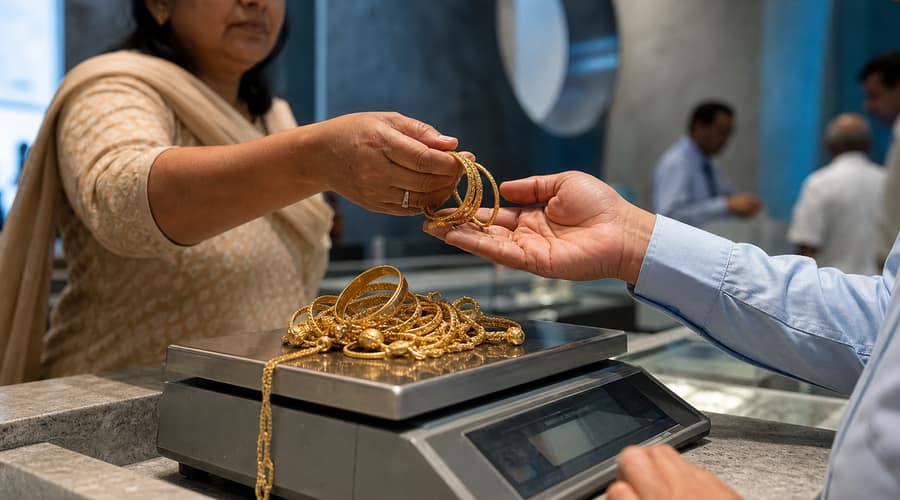
Singapore's OCBC has launched Southeast Asia's first tokenized physical gold fund, using blockchain to fractionalise bullion ownership and cut transaction costs by up to 50% for retail and mass affluent investors.
Physical gold has always carried an implicit cover charge. Storage fees, insurance premiums, and steep minimum buy-ins have kept the asset class firmly in the hands of institutions and high-net-worth clients who could absorb those frictions. OCBC just changed that calculus. The Singapore bank announced today the launch of the region's first tokenized physical gold fund, a product that converts ownership rights in real bullion into blockchain-based tokens , and in doing so, hands a far wider pool of investors a genuine stake in one of the oldest safe-haven assets on earth.
What separates this from the crowded field of gold ETFs is the physical backing. Each token represents a specific ownership right in actual bullion held by the fund, not a synthetic derivative or a contract tracking the spot price. For investors who have spent years watching gold-linked products carry counterparty risk they couldn't fully price, that distinction matters. OCBC's wealth management and private banking divisions run the fund on a permissioned blockchain, which keeps it inside a regulatory framework while enabling 24/7 trading and near-instant settlement , a meaningful operational leap from the fixed hours and T+2 settlement timelines of conventional precious metals markets.
OCBC estimates the tokenization infrastructure trims transaction costs by roughly 30 to 50 percent compared to traditional physical gold trading, where storage logistics and insurance eat into returns before a position even has time to appreciate. That compression is not a rounding error , it's the kind of efficiency gain that determines whether a product is viable for mass affluent investors or remains a niche offering. By lowering the minimum investment threshold, the bank is explicitly targeting the segment of the market that wanted physical gold exposure but couldn't justify the cost structure of getting it.
The timing is deliberate. OCBC's launch sits squarely within Singapore's broader regulatory architecture for digital assets. The Monetary Authority of Singapore's Project Guardian has been quietly building the institutional plumbing for exactly this kind of real-world asset tokenization, stress-testing frameworks that allow licensed financial institutions to move traditional assets onto distributed ledgers without stepping outside compliance guardrails. OCBC is the first in the region to put a live physical gold product through that infrastructure at scale.
What this signals for the wider market
The more consequential story here is what OCBC's move does to the competitive landscape. Regional banks have watched the tokenization conversation unfold mostly at the pilot and proof-of-concept stage. A fully operational, institutionally managed physical gold fund changes the reference point. Banks in Malaysia, Indonesia, Thailand, and Hong Kong now have a live product to benchmark against, and the pressure to follow with tokenized bond or real estate offerings will be real and immediate. A crisis is an endurance test, so you want to focus your energies on brand building activity for the longer term , and OCBC has just planted a significant flag in territory its competitors will need to contest.
For gold specifically, the implications extend beyond Southeast Asia. The metal is already having a strong 2026 on the back of persistent macroeconomic uncertainty, and the introduction of a liquid, low-friction digital wrapper for physical bullion could attract a new cohort of investors who previously sat on the sidelines. Democratized access to a safe-haven asset during a volatile macro cycle is not a trivial development , it adds a structural demand layer that didn't meaningfully exist before.
Watch for two things in the months ahead: whether MAS accelerates its Project Guardian timeline in response to this launch, and whether OCBC's product attracts enough retail volume to pressure Singapore's other major banks into announcing competing tokenized asset funds before year end. The race to digitize real-world assets in Southeast Asia just moved from theoretical to tangible.
Also read: A wrong-size gold coin from your local dealer is more than an inconvenience when gold trades above $3,300 an ounce • A Pacific Northwest jeweler just fused a wild boar tusk with 18-karat gold and the internet cannot look away • A Pacific Northwest jeweler just fused a wild boar tusk with 18-karat gold and the internet cannot look away