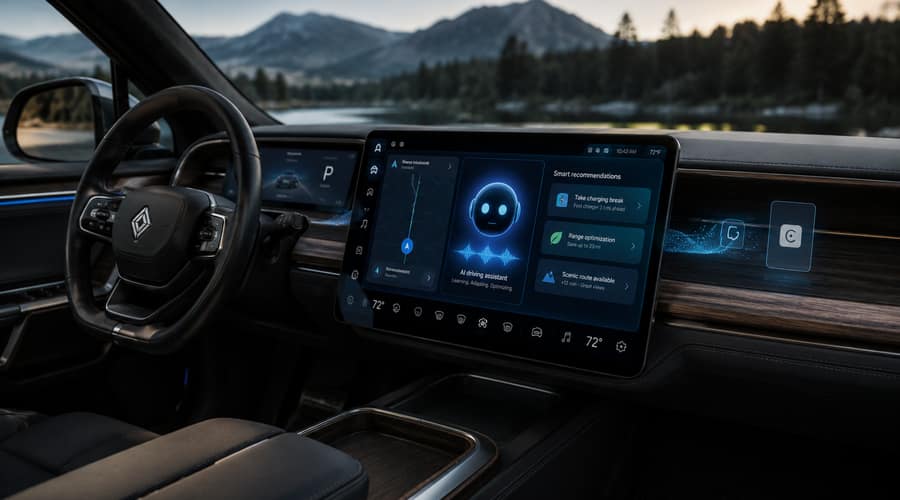
Rivian is turning its refusal to support CarPlay and Android Auto into a bigger bet on AI. The question is whether drivers want a smarter car, or just the phone interface they already trust.
Rivian has never been shy about wanting to own the software experience inside its vehicles, but its latest argument is more ambitious than a cleaner dashboard. Wassym Bensaid, Rivian’s chief software officer, now says the rise of AI agents could make the whole CarPlay debate feel dated.
That is a bold position because CarPlay and Android Auto are not fringe features. For many drivers, they are the safest and least annoying way to bring maps, music, calls, messages, podcasts and niche apps into a car without waiting for an automaker to rebuild them. Rivian is effectively saying it can replace that comfort with a voice-first system that understands the vehicle more deeply than Apple or Google can.
As The Verge reported from its Decoder interview, Bensaid said Rivian’s internal surveys once showed more than 70 percent of customers asking for CarPlay, while recent surveys put that figure below 25 percent. His argument is that Rivian has added enough native convenience, from navigation to vehicle controls, that phone projection has become less central to the ownership experience.
The bigger idea is not just that Rivian can build a decent infotainment system. It is that a modern EV is increasingly one connected computer, and the assistant sitting inside it can reach functions your phone cannot. Rivian Assistant can already interact with vehicle settings, climate, navigation, media, messaging, calling, owner guide information and alerts through the 2026.15 software update. Rivian says the feature is available on vehicles with Connect+ or an active trial.
That matters because the phone mirroring model has a limit. Apple and Google can bring excellent app ecosystems into the cabin, but they do not truly control the car. They cannot manage ride height, drive modes, charging plans, cabin preconditioning and regulated safety functions in the same integrated way an automaker can. Rivian sees that gap as its opening.
Bensaid’s example is a trip plan that connects navigation with Google Calendar, charging stops, restaurant preferences and follow-up actions like adding a summary to a calendar or sending it by text. In theory, that is useful. A driver should not have to bounce between four apps while sitting behind the wheel. If AI can reduce taps and keep attention on the road, there is a real product case here.
But the problem is obvious. Voice assistants have trained people to expect disappointment. They misunderstand simple requests, fail at edge cases, hide behind vague error messages and often turn a fast task into a conversation. In the same interview, Rivian’s assistant could change ride height and drive modes, but would not control the rear wiper because Rivian blocks certain regulated or safety-related functions. That is sensible, but it also shows why trust will be hard to earn.
The business logic is clear
Rivian’s resistance to CarPlay is not only about user experience. It is also about control. If a driver spends every trip inside Apple or Google’s interface, the automaker becomes hardware wrapped around someone else’s software relationship. That is a weak position for any company trying to sell subscriptions, improve features over time and build a software-defined brand.
This is especially important because Rivian’s software is no longer just for Rivian. Through its joint venture with Volkswagen Group, Bensaid is helping build the electrical architecture and operating system that could underpin future EVs across brands such as Volkswagen, Audi, Porsche and Scout. If Rivian proves that its stack can support richer AI interactions, it becomes more than an EV maker with nice screens. It becomes a software supplier with leverage.
The risk is that drivers may not care about the strategy. They care whether their preferred podcast app works, whether navigation is reliable, whether voice commands are faster than tapping a familiar button and whether the system still feels current five years from now. Cars stay on the road far longer than phones. A locked-in AI interface can age badly if the hardware, connectivity or business model falls behind.
There is also a privacy and dependency question. An assistant that connects calendars, messages, location, charging behavior and vehicle controls may be powerful, but it asks for a lot of trust. Automakers will need to explain where data goes, what runs locally, what depends on the cloud and what happens when a subscription lapses. Vague promises will not be enough.
Rivian may be right that the future of car software is more conversational and more integrated than phone projection. But replacing CarPlay is not a branding exercise. The AI agent has to be faster, safer and less frustrating than the thing people already know. Until then, the smartest interface may still be the one that lets the car do car things and the phone do phone things.
Also read: Rivian is betting AI can make CarPlay feel unnecessary • Stable Audio Studio brings local AI sound generation into focus • Congress is preparing truck drivers for the autonomous freight era