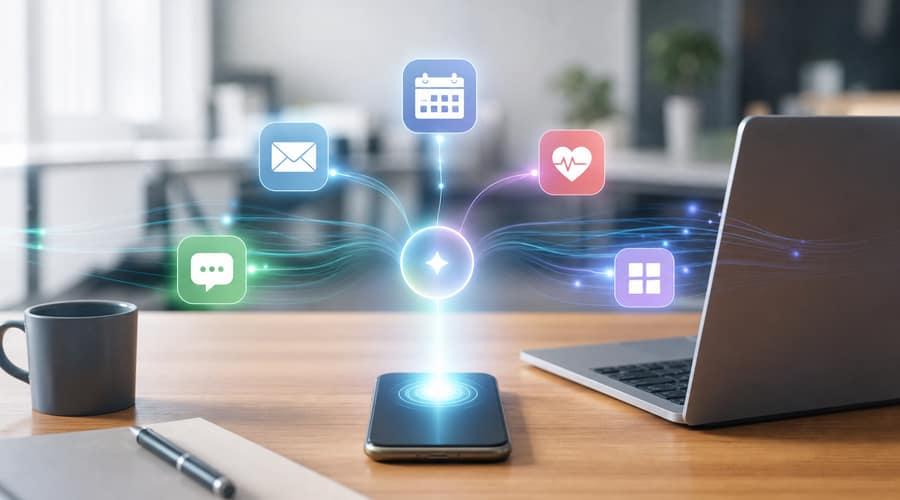
Poppy is making a direct bet that the next useful AI product will not wait for a prompt. It will watch the moving parts of your day, then step in when something actually needs doing.
The chatbot era made AI feel accessible, but also strangely passive. You ask a question, it answers. Poppy, a new assistant from San Francisco-based Second Nature Computing, is trying to move that relationship into the background, where calendars, messages, health data, rides, groceries and reminders can become part of one working picture instead of ten separate apps competing for attention.
According to a report from TechCrunch, Poppy launched today with support for Apple Calendar, Google Calendar, Gmail, Outlook, iCloud Mail, Apple Health, Reminders, Contacts, WhatsApp, Uber and Instacart, with iMessage access handled through a Mac app. That is a wide surface area for a four-person team, and it says a lot about the ambition. Poppy is not simply trying to summarize your inbox. It wants to understand the practical context around your day.
That context is where the product becomes interesting. If there is a half-hour gap between meetings and you happen to be near a park, Poppy might suggest a walk. If you are planning brunch with a friend, it can use past preferences from your messages to shape restaurant ideas. It can track flights, send a reminder about medication or surface what matters from the morning before the day has already pulled you in five directions.
This is the next battleground in consumer AI. The first wave trained people to type into a box. The next wave is about whether software can take the first step without becoming irritating, invasive or wrong at exactly the wrong time. That is a harder problem, because the assistant needs permission, memory and judgment. It needs to know the difference between useful and intrusive.
Sai Kambampati, the founder of Second Nature Computing and a former software engineer at Humane, is coming at the problem from the world of ambient computing. That background matters. Humane tried to rethink the device itself. Poppy is taking a less dramatic route by living inside the phone and the services people already use. It is a practical approach, but it also puts the company inside the territory controlled by Apple, Google and Microsoft.
For a San Francisco startup, that is both the opportunity and the danger. The largest platform companies already own the calendars, inboxes, phones, health apps and notification systems that make a proactive assistant useful. A small company can move faster and design with fewer internal conflicts, but it does not own the operating system. The iMessage workaround through a Mac app shows how fragile some of these integrations can be when the platform owner has different incentives.
Apple's App Store listing for Poppy by Second Nature also points to where the product is going. It describes a personalized briefing, widgets for the Lock Screen and Dynamic Island, routines triggered by time or location and one-tap actions such as creating a calendar event, booking a restaurant, ordering a ride or setting an alarm. That is not just information retrieval. It is workflow compressed into a card.
The privacy question is the product
The problem is that Poppy only works if users give it access to deeply personal information. Calendar data is sensitive. Messages are more sensitive. Health signals, location and contacts together create a living map of a person. Any assistant that wants to be truly useful has to see enough of that map to make good calls, and that means privacy is not a feature box. It is the foundation.
Second Nature Computing says user data is encrypted when stored in its database, and that it uses a zero-retention policy when cloud-based large language models are involved in generating suggestions. Kambampati has also said the longer-term goal is to move more of this work onto local devices as models become smaller, cheaper and more capable. That is the right direction, because the strongest version of this product is one where the assistant can be intimate without sending every signal back to a server.
The company has raised $1.25 million in pre-seed funding led by Kindred Ventures, with angel investors including DeepMind's Logan Kilpatrick. That is modest by AI startup standards, especially in a market where foundation model companies and hardware players are spending heavily. But consumer AI does not always reward the biggest budget first. It rewards trust, timing and habit formation.
Poppy now has to prove that proactive help is better than another stream of notifications. That will be the real test. If it saves users from switching apps, remembering small tasks and rebuilding context all day, it could make AI feel less like a tool and more like infrastructure. If it guesses poorly or overreaches, people will shut it off quickly.
The wider market should watch this category closely. Chatbots made AI visible, but proactive assistants could make it operational. The winners will not be the products that know the most about users. They will be the ones that use that knowledge with restraint.
Also read: SoftBank tried to buy Cerebras as AI chip scarcity reset the IPO market • Tower Semiconductor turns AI demand into capacity commitments • AI is rewriting utility leverage in Lake Tahoe's power fight