

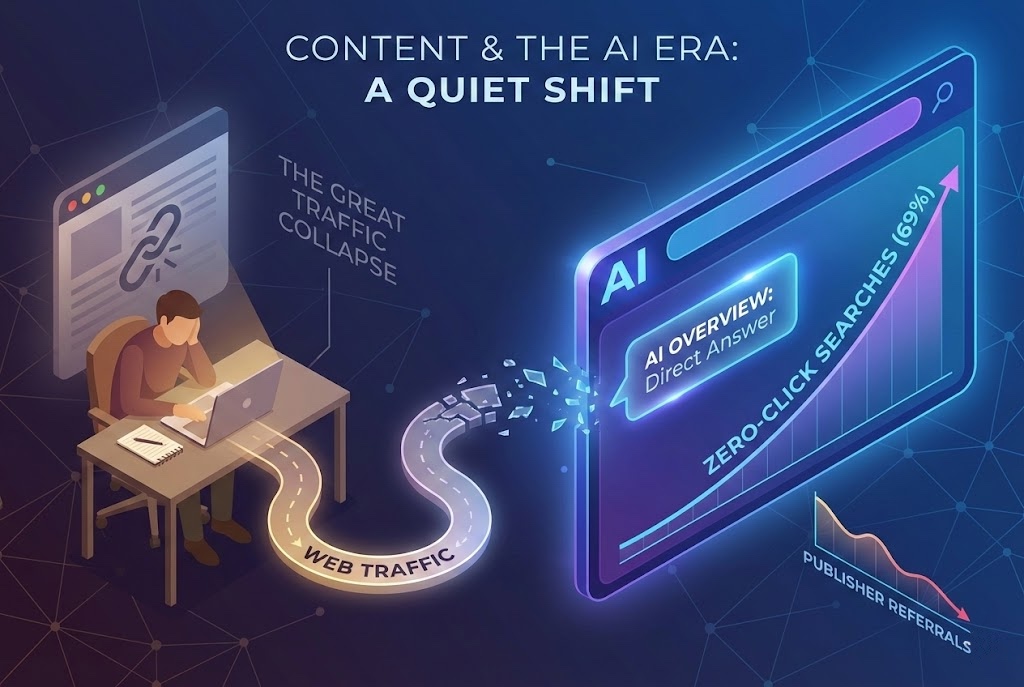
There’s a quiet massacre happening on the internet right now. And if you’re a blogger, a small publisher, or any kind of content creator who has spent years building an audience through search engines – you might already be feeling the blade.
The numbers don’t lie. According to Similarweb’s data, zero-click searches on Google have jumped from 56% to a staggering 69% in just one year. That means nearly 7 out of every 10 people who search for something on Google now get their answer without ever clicking on a single link. They ask, Google’s Ai answers, and they move on with their lives.
So where does that leave the person who actually wrote the content that Ai just summarized?
Nowhere. Absolutely nowhere.
The Great Traffic Collapse
Let me put this into perspective for you. Organic traffic to U.S. websites dropped from 2.3 billion visits per month at its peak in mid-2024 to under 1.7 billion by May 2025. That’s over 600 million lost visits in less than 12 months. And we’re not talking about small-time blogs here – major publishers are bleeding out.
CNN’s traffic declined between 27% and 38% year-over-year. Business Insider saw its organic search traffic fall by 55% between April 2022 and April 2025, leading the company to cut 21% of its staff. HubSpot, a marketing giant, reportedly lost 70–80% of its search traffic. And these are the big players with resources, teams, and decades of brand recognition behind them.
Now imagine what’s happening to the independent blogger running a travel site from their living room. Or the small business owner who spent years writing helpful guides to attract customers. Or the freelance writer who built a niche site that finally started making money after years of hustle.
THEY’RE GETTING CRUSHED. AND MOST OF THEM DON’T EVEN FULLY UNDERSTAND WHY.
The Ai Answer Machine
Here’s how it works. You type a question into Google. Instead of showing you the traditional list of ten blue links, Google now displays what it calls “Ai Overviews” – a synthesized answer pulled from multiple sources and generated by its Ai system.
It looks clean. It feels convenient. And for the user, it’s brilliant.
But here’s the dirty little secret: that answer was built on the backs of content creators who will never see a single visitor from it. The Ai scraped their articles, extracted the useful bits, and served it up as Google’s own response.
As of 2025, Ai Overviews appear in up to 47% of searches. When they show up, click-through rates plummet from 15% to just 8%. And only 1% of users bother clicking on the citation links within the Ai Overview itself.
In other words, your content is being used to generate answers that keep people away from your website.
This isn’t a partnership. It’s parasitism.
The Rise of Conversational Search
But Google isn’t the only culprit. ChatGPT, Gemini, Perplexity, Claude – the entire ecosystem of Ai chatbots has fundamentally changed how people seek information.
Why would someone sift through ten articles when they can just ask ChatGPT a question and get a tailored, conversational response in seconds? Why would a student research multiple sources when Gemini can summarize everything they need for a school project? Why would a home cook browse recipe blogs when they can describe what’s in their fridge and get a custom meal plan?
The convenience is undeniable. But the cost is being paid by the people who create the content these systems were trained on.
From February 2024 to February 2025, search engine referrals to publishers dropped by 64 million. Meanwhile, Ai chatbot referrals grew by just 5.5 million. That’s a net loss of nearly 60 million referrals – and the gap is only widening.
The SEO Graveyard
For over two decades, search engine optimisation was the golden ticket. Build good content, optimize for keywords, earn backlinks, and watch the traffic roll in. Entire industries were built around this formula. Careers were made. Businesses thrived.
But that playbook is becoming obsolete.
A study of 50,000 B2B websites revealed that 73% experienced significant traffic loss between 2024 and 2025, with the average decline hitting 34% year-over-year. Traditional SEO tactics that worked five years ago are now actively hurting performance as search engines prioritize comprehensive, Ai-friendly content over keyword-optimized articles.
The professionals are calling this “the great decoupling” – search impressions are climbing higher than ever, meaning your content is being seen, but clicks are declining because users are consuming that content within Google’s ecosystem rather than visiting your site.
You’re getting credit for being visible without getting any benefit from it. It’s like being famous but broke.
What About the Little Guys?
Here’s what really bothers me about all of this.
The Ai companies training these models scraped content from everywhere. Travel bloggers, recipe creators, tech reviewers, health writers – anyone who ever published something useful on the internet contributed to the training data that makes ChatGPT and Gemini so smart today.
Did they ask permission? Rarely.
Did they compensate creators? Almost never.
And now those same creators are watching their livelihoods disappear as users bypass their websites entirely and go straight to the Ai that learned from their work.
Some publishers are filing lawsuits. A coalition of independent European publishers filed an antitrust complaint against Google in 2025, arguing that Ai Overviews represent an abuse of market dominance. Meta admitted in court documents that it trained its Ai on content from Library Genesis – a shadow library of pirated books and research papers.
But for every lawsuit that gets filed, thousands of small creators simply go quiet. They can’t afford lawyers. They can’t compete with trillion-dollar tech companies. They just close their blogs, stop writing, and move on.
Is There Any Hope?
I’d be lying if I said the situation wasn’t bleak. But there are some glimmers.
First, ChatGPT is actually sending traffic to publishers – referrals grew 25 times year-over-year according to some reports. Sites like Reuters, The Guardian, and Business Insider have seen meaningful traffic from ChatGPT’s citations. It’s still a tiny fraction compared to what Google used to send, but it’s something.
Second, some publishers report that while their traffic is down, the quality of visitors is up. Fewer casual browsers, more genuinely interested readers. Higher conversion rates. More engagement. If Ai is filtering out the window shoppers, perhaps the remaining traffic is worth more than the raw numbers suggest.
Third, new compensation models are emerging. Perplexity launched a revenue-sharing program with publishers. OpenAI has signed licensing deals with major news organizations. The economics are still unclear, and the payouts are nothing compared to what search traffic used to generate, but at least there’s acknowledgment that content creators deserve something.
The Question We Need to Ask
At the end of the day, this raises a fundamental question about the future of the internet: if creators can’t earn from their work, how long will they keep creating?
The irony is that Ai systems need human-created content to function. Without fresh articles, research, opinions, and creative works, these models would have nothing to learn from. They’re essentially eating the seed corn – consuming the content ecosystem that sustains them.
We’re already seeing the early signs of this. Some websites are blocking Ai crawlers entirely. Others are putting their best content behind paywalls where bots can’t reach it. A few are exploring decentralised publishing platforms that cut out the middlemen entirely.
The open web as we knew it – where anyone could publish content and earn a living through advertising and search traffic – might be reaching its end.
Where Do We Go From Here?
If you’re a content creator reading this, I’m not going to sugarcoat it: the old model is dying. But that doesn’t mean opportunity is dead.
The creators who will survive are the ones who build direct relationships with their audiences. Email lists, memberships, communities – anything that doesn’t depend on a third-party algorithm to reach your people.
The creators who will thrive are the ones who offer something Ai can’t replicate: unique perspectives, original research, authentic human connection. Ai can summarize. It can compile. But it can’t have lived experiences. It can’t develop genuine expertise through years of practice. It can’t build trust with an audience over time.
As someone who started out delivering newspapers and ended up becoming a correspondent for those same papers, I’ve learned that the path forward isn’t always obvious. Sometimes the very thing that feels like an ending is actually the beginning of something new.
The web search era might be ending. SEO as we knew it might be dying. But the need for quality information, authentic voices, and valuable content isn’t going anywhere.
The question is whether the systems we build next will actually reward the people who create that content – or whether we’ll let Ai companies harvest everything while giving nothing back.
That’s a question worth discussing. And it’s one we all have a stake in answering. Thanks for reading and have a fantastic (hopefully) new year!
You mean the era of, “Look At Me!, Look At Me!, Look At Me! Aren’t I Fabulous?” narcissism Is coming to an end. I’m so sad.