

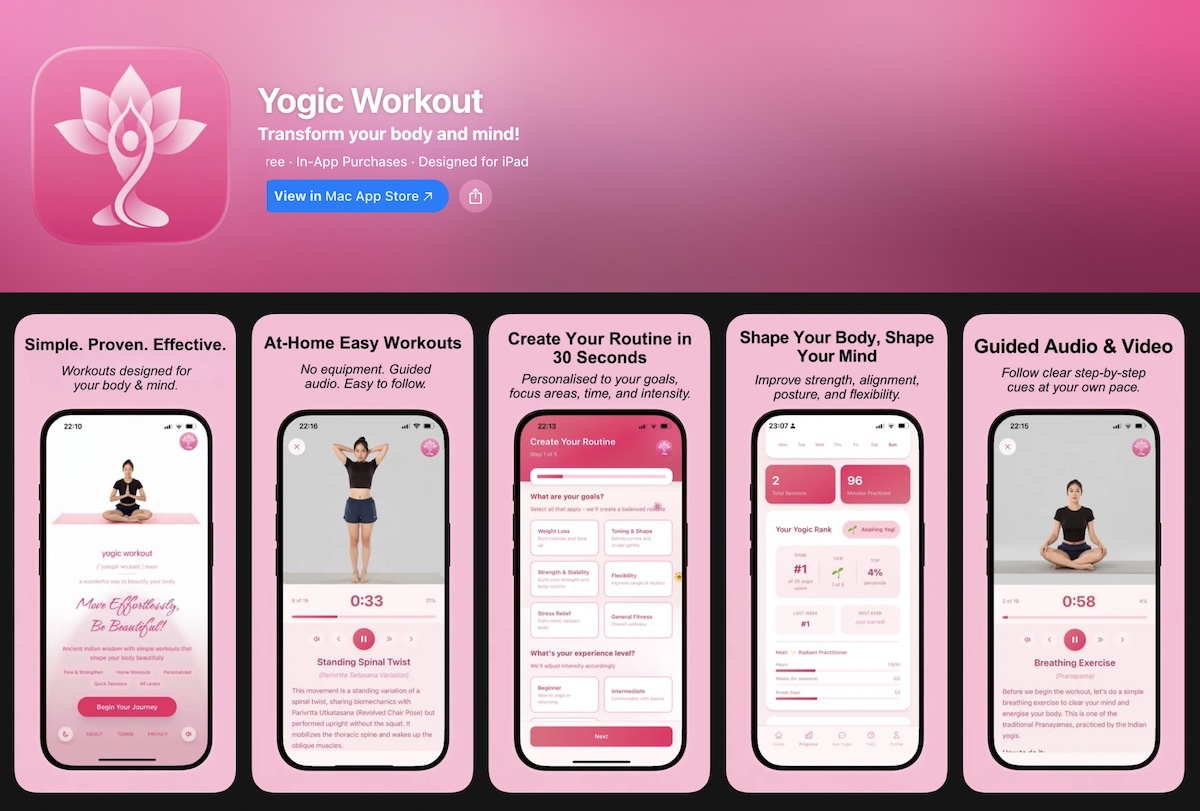
Yogic Workout is a workout app that brings traditional yogic exercises to your phone – no equipment needed, just you and your space at home. What makes it stand out is its personalised approach, creating custom workout routines for each user with video guides, audio instructions, and detailed descriptions that all work together seamlessly. Today we’re speaking with Hiro, the developer behind the project, to talk about how it all came together. [The app can be found at:https://apps.apple.com/in/app/yogic-workout/id6756184091]
For readers who don’t know you yet, can you tell us a bit about yourself and your background in tech?
I’ve been a developer for quite some time now, mostly building web3 stuff – dApps, smart contracts, backend systems, that kind of thing. Worked with different founders on early-stage projects over the years. The recent market turmoil hit pretty hard though, projects dried up and so did work. That’s when I started looking at other areas where I could use the same skills.
What led you from web3 into building a fitness app, and how did Yogic Workout come about?
Honestly it wasn’t planned at all. A couple of founders I worked with before on another project reached out and asked if I could build an iOS app for them. I had no idea how to do it – didn’t even know about Xcode, never dealt with App Store submissions, nothing. But I said yes, figured I’d get the job first and then find out how to do it afterwards. The project sounded interesting and I trusted their vision so I just went for it.
What was the original idea behind Yogic Workout, and what makes it different from other fitness apps?
The goal was to create a yogic-style workout app people could use at home without any equipment. Most fitness apps give you the same routines everyone else gets but this one creates custom workout plans based on what each user needs – their goals, how much time they have, fitness level, all that. And the content is very authentic, some of these techniques are from practices that go back centuries. Simple things but pretty cool.
How long did it take to build the app from start to launch?
About six weeks from first line of code to App Store launch. That included learning the whole iOS publishing process, handling subscriptions, fixing post-launch issues, everything. Been wanting to write about it for a while but kept running into more stuff to fix after launch. Now it’s on version 1.02 with all the major issues sorted out. Intense but probably the fastest and most educational build I’ve done.
You didn’t have prior iOS experience. How did you approach that learning curve while still delivering a real product?
I leaned on what I already knew – system design, frontend stuff, backend logic – and just adapted it to a new platform. My process was pretty straightforward actually. I’d build and push on the website first, then on mobile I’d create a shortcut using Safari to test it so it gives me an exact app output. This helped me fix issues without having to update the app itself every time. Then I’d pull it to Xcode and publish to App Store. So many steps but once you get the hang of it it’s pretty smooth.
The app combines video, audio guidance, and background music. What were some of the more challenging technical parts?
The three audio layers thing was tricky – background music that plays continuously, then voice guidance on top of that, then the video sound. Getting them to play together without clashing or cutting each other out took some work. I actually had to talk to ChatGPT and Gemini to figure it out, shared their responses back and forth, made a document and gave it to Claude and it works flawlessly now. Subscription handling and App Store edge cases after launch were also more complex than I expected.
You’ve mentioned using AI tools during development. How did they fit into your workflow?
I used Claude for all the coding – gave it complete details on what to build, what modules, what features, and it did the work. Didn’t write a single line of code on my own. When Claude got stuck I’d talk to ChatGPT or Gemini. ChatGPT was great for talking things through since it has voice, I’d just speak to it when I was too lazy to type out documentation. Each tool has its strengths and knowing how to use them all gives you an edge. But yeah the direction and decisions were always mine, AI is just an incredibly capable assistant.
The app has really good content – videos, audio guides, all of it. How much work went into that?
The founders handled all the content, I just did the tech side. But I can tell they put serious effort into it. Especially the audio guides – they’re very precise and minimal, just enough to guide you through without being annoying. They also gave detailed text descriptions for people who want to read. I actually had to google some of the stuff they mentioned, some breathing techniques are from ancient practices. The content quality really shows their commitment, that’s what makes my job easier when the people you work with know exactly what they want.
Monetization is always the hard part with fitness apps. How is Yogic Workout handling that?
Subscription model. The founders were pretty stubborn about not having ads – they said it’s bad UX to show ads to people who just want to do a workout and I honestly agree with them. So it’s a simple subscription that unlocks everything, no ads interrupting your flow. I’m really hoping it does well for them because they’ve put a lot into this.
Now that the app is live, what’s next for Yogic Workout?
Right now I’m working on a breathing exercises module which is actually pretty fascinating even for me to build. Android version is coming too once we finish adding all the features they want on iOS. I’m the only dev on this so we’re taking it step by step but the founders have a clear vision of where they want to take this. There’s a lot more planned.
The app can be found on the Apple App Store by simply searching for Yogic Workout, or at https://apps.apple.com/in/app/yogic-workout/id6756184091