Japan's space researchers have unveiled an inflatable habitat that could reshape how humans live beyond Earth, and the idea is deceptively simple.
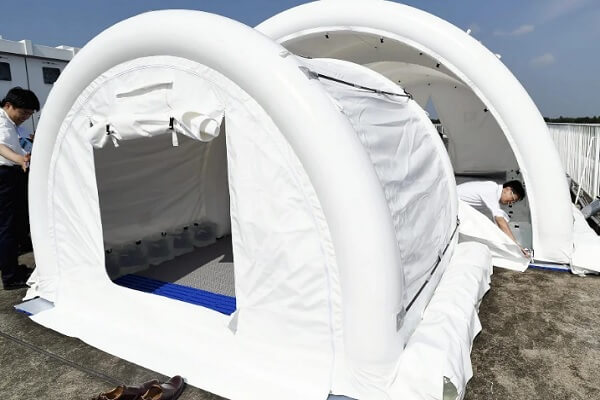
Living in space has always meant squeezing into cramped metal tubes. But a team of Japanese researchers thinks there is a better way: inflate your home after you get there. The Space Colonies Research Center at Tokyo University of Science, working with Shimizu Construction and the Japan Aerospace Exploration Agency (JAXA), has built a prototype habitat that launches compressed and then expands like a balloon once it arrives. They unveiled it on the 30th at the university's Noda Campus in Chiba Prefecture.
The concept is straightforward, but the engineering behind it is anything but. The habitat is constructed from polyester fiber fabric, the same kind of material you might find in high-performance outdoor gear but engineered to withstand the unique pressures and radiation conditions of space. When packed for launch, the entire structure compresses down to roughly one meter long and 50 centimeters thick. That compact form factor is what makes the idea so appealing from a cost perspective. Rocket launches are priced by weight and volume. Every cubic centimeter of cargo space costs a fortune to send skyward, so a habitat that can fold down to the size of a large suitcase represents a meaningful reduction in launch expenses.
Once inflated with air, the structure expands into a kamaboko-shaped living space approximately eight meters long, five meters wide, and 2.5 meters high. Kamaboko, for those unfamiliar, is a curved, semi-cylindrical shape common in Japanese architecture and design. The result is a surprisingly roomy interior that could comfortably serve as a workspace or living quarters for astronauts on extended missions. The shape itself is no accident. The curved design distributes pressure evenly across the surface, which is critical when you are dealing with the difference between internal atmospheric pressure and the vacuum outside.
Right now the interior sits empty, a blank canvas waiting to be filled. But that emptiness is temporary and intentional. The research team has ambitious plans for what comes next. Future experiments will test vegetable cultivation inside the structure, exploring whether fresh food can be grown reliably in an inflatable environment far from Earth. Water purification systems will also be tested, addressing one of the most fundamental challenges of long-duration space habitation. If you cannot recycle water efficiently, you cannot stay for long.
The project is not meant to stay confined to one institution. Participants from other universities and private companies will be invited to contribute their expertise, developing new technologies for energy supply, food production, and other essentials that a functioning space colony would require. This collaborative approach makes sense. No single organization has all the answers when it comes to sustaining human life in an environment this hostile, and the problems are too complex for siloed thinking.
Chiaki Mukai, director of the research center and a veteran astronaut, framed the project's significance with characteristic directness. "It is difficult to compete with Russia, the United States and China with rockets and satellites, but I think Japan can win in the field of clothing, food and housing," she said. That observation captures something important about the emerging space economy. Launch capacity and satellite deployment will continue to be dominated by the biggest players with the deepest pockets. But life support, habitability, and the everyday technologies that make long-term space living tolerable represent a different kind of competition entirely. Japan has a long cultural tradition of doing more with less, of optimizing small spaces and limited resources. Those instincts translate remarkably well to space habitation.
The inflatable habitat model also aligns with broader trends in the commercial space industry. Companies like Sierra Space and Bigelow Aerospace have pursued similar concepts, recognizing that rigid structures launched from Earth will always face fundamental size limitations. If humanity is serious about building permanent bases on the Moon or Mars, the habitats will almost certainly need to be fabricated or inflated on site using materials that are light enough to transport economically.
What makes this Japanese effort notable is the breadth of its ambition. This is not just a structural experiment. The integration of food production, water recycling, and energy systems into the same research program suggests a holistic vision for what a colony would actually need to function. The prototype on display in Chiba Prefecture may look like an empty fabric shell today, but it represents a first step toward solving problems that every spacefaring nation will eventually face. The question is no longer whether humans will live in space, but how comfortably they will do it.