
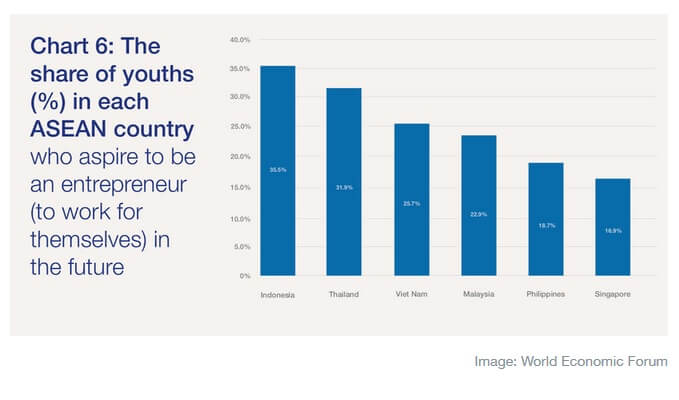
More than a third of young Indonesians aged 15 to 35 want to work for themselves, according to a World Economic Forum survey.
This may seem surprising given the country's recent series of burgeoning technology unicorns, those new billion-dollar businesses that have captured headlines and inspired a generation. But dig a little deeper and the picture becomes clearer.
Business leaders like Ferry Unardi, who built Traveloka into one of Southeast Asia's leading travel booking platforms, and Nadiem Makarim, who founded the ride-hailing giant Gojek, have proven that young entrepreneurs can transform emerging technology companies into billion-dollar operations in relatively short order. Their success stories have become cultural touchstones for Indonesian youth considering their career paths.
Indonesians are not alone in dreaming of commercial success. The World Economic Forum's latest annual survey of youth attitudes across the ten countries of the Association of Southeast Asian Nations reveals a region full of entrepreneurial spirit and ambition.
The survey asked respondents what type of organization they work for today and where they would like to work in the future. In Indonesia, 34.1% of young people are currently self-employed and another 1.5% aspire to be. Those numbers tell a story of a workforce that increasingly values autonomy and self-direction over traditional corporate career paths.
Vietnam shows similar patterns. More than a quarter of Vietnamese youth have expressed clear commercial aspirations. The country has nurtured its own crop of successful technology ventures, including agricultural technology company Hachi, which uses Internet of Things sensors to power smart irrigation systems for rice mills, with the aim of reducing water waste and increasing crop productivity. It is the kind of innovation that shows entrepreneurship in the region is not limited to consumer apps and delivery services.
Across the broader ASEAN region, the survey found that slightly more than 26% of respondents were self-employed, a modest but meaningful increase over the previous year. Meanwhile, almost 1% more expressed entrepreneurial aspirations for the future. When you combine those who already run their own businesses with people working for startups, the total accounts for nearly one-third of all ASEAN youth. That figure underscores just how attractive business ownership has become.
Not all of this entrepreneurial energy springs from the same source. In some countries and economic situations, the desire to strike out on one's own may be driven more by necessity than by dreams of building the next Gojek or Traveloka. When formal employment options are limited or wages remain low, people feel they have no real choice but to create their own income streams. This distinction between opportunity-driven and necessity-driven entrepreneurship matters because it shapes what kind of support and infrastructure these young business owners actually need.
Governments across the region have taken note. Indonesia has rolled out programs to support digital skills training and micro-lending initiatives aimed at young entrepreneurs. Vietnam has introduced similar measures, with state-backed incubators supporting startups in agriculture, logistics, and financial technology. The Philippines and Thailand have also launched entrepreneurship education programs targeting university students.
Access to capital remains one of the biggest barriers. Traditional banks in many ASEAN countries still require collateral that young founders simply do not have. Fintech platforms have stepped in to fill part of that gap, offering microloans and alternative credit scoring models that look at digital payment histories rather than traditional assets. These platforms are making it possible for a wider range of young people to get started.
Digital connectivity has also lowered the barrier to entry in ways that would have been unimaginable a decade ago. A smartphone and an internet connection are now enough to launch an online store, offer freelance services, or build a social media following that generates real income. Social commerce, selling products directly through platforms like Instagram and TikTok, has become a genuine career path for thousands of young Southeast Asians.
The trend carries significant implications for the broader economy. A generation that prefers self-employment over corporate jobs will demand different things from policymakers: better digital infrastructure, more flexible regulatory environments, and education systems that teach practical business skills alongside academic subjects.
As the World Economic Forum's data makes clear, entrepreneurship in Southeast Asia is no longer a fringe pursuit. It is becoming the mainstream aspiration for a substantial portion of the region's youth. The question now is whether the ecosystem around them can keep pace with their ambitions.