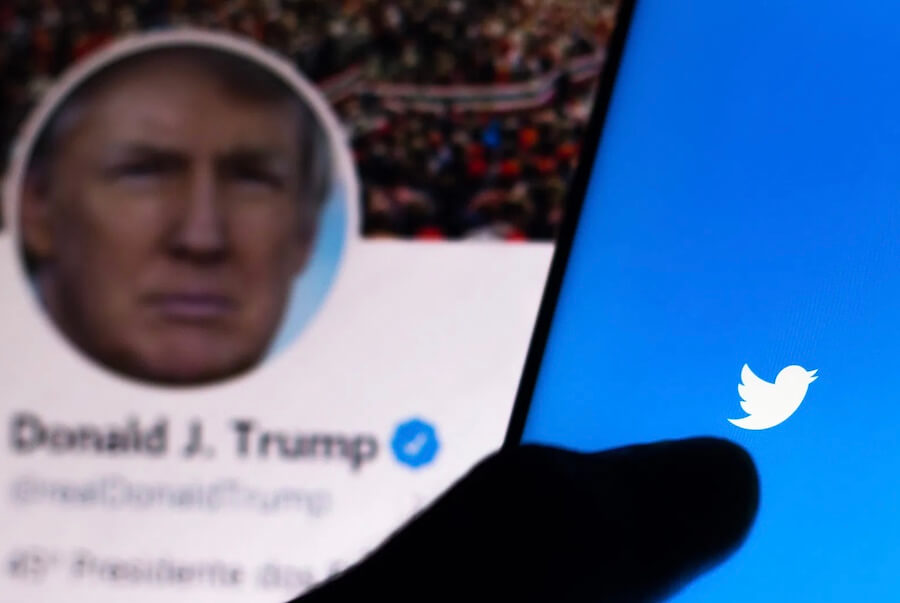
Twitter permanently suspended President Donald Trump's account, ending his most powerful direct communication channel with 88 million followers after years of debated moderation.
Social media platform Twitter permanently banned the account of President Donald Trump on Friday following the unfortunate events that took place at the US Capitol on Wednesday. The decision marked an extraordinary step by a technology company against a sitting US president, cutting off his most direct line of communication to the public just days before the end of his term.
After close review of recent Tweets from the @realDonaldTrump account and the context around them we have permanently suspended the account due to the risk of further incitement of violence.https://t.co/CBpE1I6j8Y
— Twitter Safety (@TwitterSafety) January 8, 2021
"Our public interest framework exists to enable the public to hear from elected officials and world leaders directly. It is built on a principle that the people have a right to hold power to account in the open. However, we made it clear going back years that these accounts are not above our rules and cannot use Twitter to incite violence. We will continue to be transparent around our policies and their enforcement," stated the Twitter Safety department in a detailed blog post explaining the rationale.
Twitter's decision followed two tweets by Trump Friday afternoon that would end up being his last. The tweets violated the company's policy against glorification of violence, Twitter said, and "these two Tweets must be read in the context of broader events in the country and the ways in which the President's statements can be mobilized by different audiences, including to incite violence, as well as in the context of the pattern of behavior from this account in recent weeks."
The company had already taken the unprecedented step of locking Trump's account temporarily on Wednesday following the Capitol breach, requiring removal of specific tweets before access could be restored. At that point, Twitter warned that future violations would result in a permanent suspension. When Trump's final two posts on Friday crossed that threshold, the platform followed through on its warning.
The move carries immense weight for digital political communication. Trump had effectively used Twitter as his primary press office throughout his presidency, bypassing traditional media to speak directly to his base of supporters. His account had amassed roughly 88 million followers and every tweet generated immediate global news coverage, market reactions, and policy discussions. Losing that channel fundamentally alters the information ecosystem that defined his political career.
Civil rights leaders who have long criticized tech platforms for spreading hate speech and division welcomed Twitter's decision.
Jonathan Greenblatt, the CEO of the Anti-Defamation League, called it an "excellent step."
"A fitting end to a legacy of spewing hate and vitriol," Greenblatt said. "President Trump incited the violent riots at the Capitol using social media & paid the price."
Eric Naing, a spokesman for Muslim Advocates, said Twitter "is showing real leadership."
"As Twitter notes, letting Trump continue to post tweets, Facebook posts and YouTube videos for his white nationalist supporters risks 'further incitement of violence,'" Naing said. "Now it is up to Facebook and Google/YouTube to follow Twitter's lead." As CNN reported, the pressure on other platforms intensified almost immediately after Twitter's announcement.
Indeed, the ripple effects were swift. Facebook and Instagram had already suspended Trump's accounts indefinitely through at least the end of his presidency, with CEO Mark Zuckerberg stating the risks of allowing the president to continue using the platform were "simply too great." Snapchat and Twitch followed with similar actions. The coordinated platform enforcement against a world leader represents a significant escalation in how technology companies approach content moderation at the highest levels of political power.
Critics of the bans raised concerns about the concentration of power in the hands of a few tech executives. Russian opposition politician Alexei Navalny warned that the precedent could be weaponized by authoritarian governments to silence dissenting voices. Others questioned whether private companies should hold the authority to silence elected officials, regardless of the circumstances.
What remains clear is that the relationship between technology platforms and political power has shifted permanently. For years, social media companies operated with a light touch on content from world leaders, arguing that public interest weighed in favor of keeping such accounts active. Twitter's decision signals that even the highest office in the land is not immune to platform rules when the risk of real-world harm crosses a certain threshold. The question now is whether this enforcement approach will apply consistently to other leaders who use social media to stoke unrest, or if it remains a singular response to an extraordinary moment in American politics.