SenseHawk, a California and Bengaluru-based SaaS startup, uses AI and drone technology to help solar companies manage every stage of a solar plant's lifecycle, from design to operation.
Startups are leading a new way to help the world switch to renewable energy to combat the effects of climate change. But things have been approached differently by California and Bengaluru-based SenseHawk. The aim of this SaaS startup is to help solar companies monitor solar plants, streamline processes, and use automation to increase productivity across the board.
The startup was founded in 2018 by Swarup Mavanoor and Rahul Sankhe. The AI-powered SaaS startup offers a cloud-based platform and an integrated set of applications to support everything from solar plant design and construction to operation and maintenance. Rather than building another dashboard that just collects dust, the founders set out to build something that would fundamentally change how solar projects are managed from the ground up.
Co-founder and CEO Swarup says that the duo was working for renewable energy company SunEdition where he was responsible for leading the solar irrigation segment while Rahul held the position of Managing Director, India, and Director, Residential Solar Business, Asia Pacific Region. Their shared experience in the trenches of solar development gave them a clear view of where the industry was falling short.
"Whenever we met, we discussed and realised that we were always caught unaware by problems that occurred at some point in time through our development, construction, and commissioning processes. We never believed we were making optimal choices in terms of acquiring a piece of land or creating a budget. We always used to eat into our contingency budget; the reason was lack of good data. The data used to be in excel sheets, emails, and people's minds," says Swaroop. This is a familiar frustration in the renewable energy sector, where decisions worth millions are often made on incomplete information stitched together from scattered sources.
The duo decided to solve these problems by tapping technology. Their first shot was getting data and hence used drones to monitor solar projects. Drones provided a fast and accurate way to survey large solar installations, capturing thermal imagery and topographical data that would take ground-based teams days or even weeks to collect manually. But collecting data was only half the battle. The real challenge was making that data actionable for the teams on the ground.
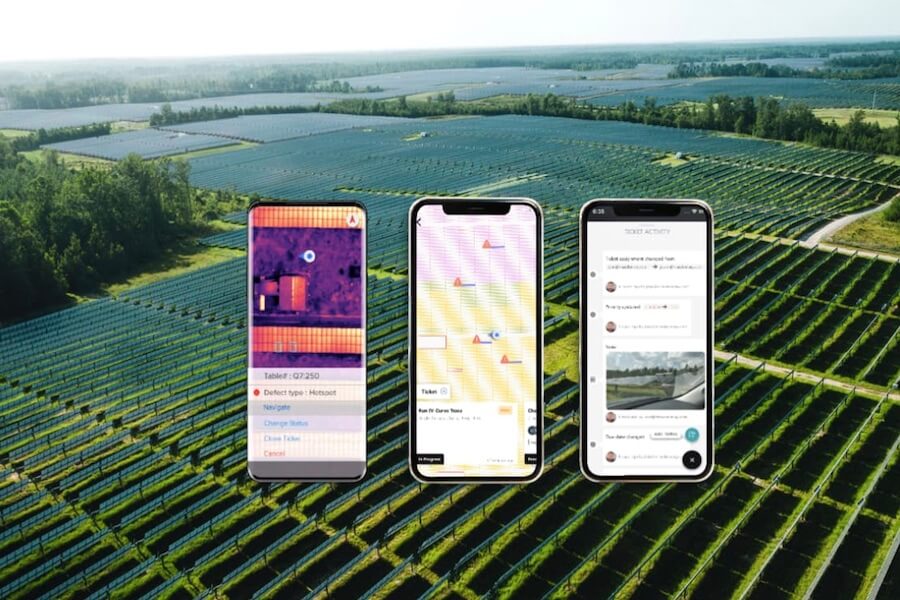
The duo decided to build an AI tool that brought together everything solar businesses need. The AI-powered software helps businesses to take care of site data management, drone data analytics, topography design, layout management, monitoring and reporting, site navigation, drone thermography, and work management. They needed all the data related to construction, terrain management, design layout, material management, legal information, and more on a single platform. By centralizing all of this information, SenseHawk eliminates the need to juggle between disconnected tools and reduces the risk of costly miscommunication.
Onsite navigation is also supported by SenseHawk's mobile application. Everything done in a solar plant can be managed on their system. The system is a digital twin of a solar site, giving teams a living, breathing representation of the project that updates in real time as conditions change. Field technicians can navigate directly to problem areas identified by drone thermography, log issues on the spot, and track resolution without ever returning to a desk.
According to the founders, leveraging its AI and machine learning application modules can help solar companies reduce costs, enhance workforce productivity, and improve solar site performances. In an industry where margins are tight and project timelines are unforgiving, even small gains in efficiency can translate into significant savings across a portfolio of sites. As solar capacity continues to scale globally, tools like SenseHawk's platform will become less of a luxury and more of a necessity for developers trying to stay competitive in an increasingly crowded market.