
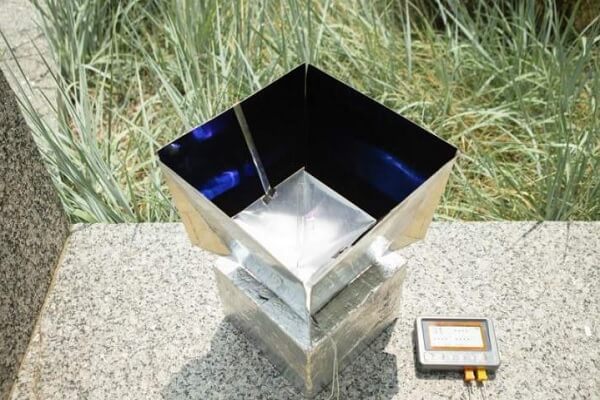
Researchers from the United States and Saudi Arabia have built a passive cooling system that lowers temperatures by up to 11 degrees Celsius without drawing a single watt of electricity.
The global push for energy efficiency has produced its share of clever innovations, but a new collaboration between American and Saudi institutions may have delivered something genuinely practical. Teams from the State University of New York at Buffalo, the University of Wisconsin-Madison, and King Abdullah University of Science and Technology have developed a passive cooling device that directs heat away from buildings with remarkable precision. The system requires no electricity, relies on no moving parts, and can be manufactured from relatively inexpensive materials.
At the heart of the device is an aluminum film coated with a polymeric material called polydimethylsiloxane. This combination serves two complementary functions. The aluminum layer reflects incoming sunlight, preventing the surface from absorbing solar radiation during the hottest hours of the day. Meanwhile, the polymer coating absorbs ambient heat from the surrounding air and channels it outward. The result is a material that actively pulls thermal energy away from whatever space sits beneath it.
The researchers then engineered a clever housing to maximize this effect. They placed the coated film at the bottom of a specially designed box roughly 46 centimeters tall and 25 centimeters long and wide. Four outwardly inclined walls made of solar-absorbent material form an inverted pyramid shape in the center. The film captures heat from inside the enclosure, while the angled walls radiate that thermal energy outward into the atmosphere and simultaneously block additional sunlight from entering the system.
What makes this approach notable is how it handles heat radiation. Thermal energy typically disperses in every direction, which limits the efficiency of most passive cooling methods. This device, however, can focus heat dissipation in a specific direction, much like car headlights concentrate light onto the road ahead. That directional control makes the technology particularly well suited for high-rise buildings in dense urban areas, where conventional cooling systems struggle with heat trapped between structures.
As reported by the Xinhua News Agency, the research published in the journal Nature Sustainability shows that the device can reduce the temperature of a small enclosed space by up to 6 degrees Celsius during daytime hours and by as much as 11 degrees Celsius at night. These are meaningful reductions, especially in regions where air conditioning accounts for a substantial share of electricity consumption during summer months.
The compact dimensions of each unit make rooftop deployment straightforward. Multiple devices can be arranged across the surface of a building roof, working in parallel to lower interior temperatures without any mechanical infrastructure. For commercial property owners and city planners looking to cut energy costs and reduce carbon footprints, this kind of modular, zero-energy cooling could prove attractive.
The broader implication is worth considering. Urban heat islands, those pockets of elevated temperature that plague concrete-heavy cities, are intensifying as climates warm. Traditional air conditioning only compounds the problem by dumping additional heat into the environment while consuming vast amounts of electricity. A passive system that removes heat directionally, without adding to the thermal load or demanding power from the grid, addresses both issues simultaneously.
Commercial viability will depend on manufacturing costs at scale and how the devices perform across different climates and building types over extended periods. But the science is solid, and the design is elegantly simple. If further testing confirms the early results, expect to see building developers and sustainability-focused municipalities taking a serious look at this technology within the next few years.