
According to the latest Grant Thornton's International Business Report, the percentage of women in senior management is rising at a remarkable rate in Vietnam, making it the number one country in the world in terms of gender parity initiatives at senior levels in business establishments.
Vietnam has a higher ratio of companies ensuring equal access to developmental opportunities at 56 percent, compared to the global average of 34 percent, according to a recent report released by global consulting company Grant Thornton International. The country is followed by Nigeria, India, and Indonesia in the rankings, underscoring a broader shift in emerging economies taking the lead on workplace gender inclusion.
The ASEAN region came in third in the top five regions in terms of the proportion of women in senior management, behind Africa which came in first with 38 percent and second-placed Eastern Europe with 35 percent. This regional performance reflects sustained investment in education and workforce participation across Southeast Asia, where governments and businesses alike have recognized that diverse leadership teams deliver stronger results.
Meanwhile in Singapore, the number of women in C-suite positions has grown in 2020. The research found 2 percent more female CEOs, 4 percent more COOs, and 9 percent more CFOs in comparison to 2019. The gains are modest but meaningful, particularly in a market where senior leadership roles have historically been dominated by men.
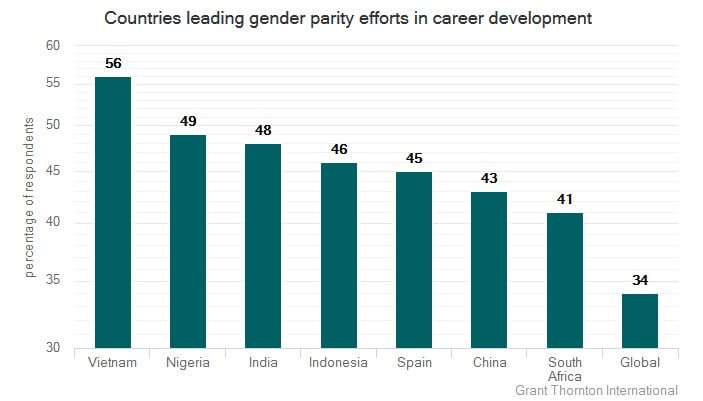
For enabling flexible working conditions, allowing women to change their work schedule at their convenience, Vietnam scored 56 percent, well above the global average of 31 percent. In terms of businesses making efforts to create an inclusive culture, Vietnam scores 58 percent, compared to 34 percent globally. Vietnam's ratio of women in senior management, 33 percent, is also higher than the global average of 29 percent. These numbers are not accidental. They reflect deliberate policy choices by Vietnamese companies that have invested in mentorship programs, parental leave policies, and transparent promotion pathways.
In Vietnam, 95 percent of businesses have at least one woman in senior management, compared to 87 percent globally. The most popular positions for female senior leaders in Vietnam are human resources director, chief finance officer, and chief operating officer. While these roles represent meaningful influence over company operations, the pipeline to CEO positions remains narrower. Closing that gap will require companies to move beyond traditional role assignments and actively sponsor women into revenue-generating and strategic leadership positions.
The contrast between Vietnam's progress and the slower pace of change in many Western economies is striking. While regions like North America and Western Europe continue to debate the merits of diversity mandates, Vietnamese businesses have simply gotten on with it. The results speak for themselves.
Francesca Lagerberg, global leader at Grant Thornton International, said the path forward requires more than good intentions. "If we want to continue to see more women in senior positions, businesses need to be intentional. Policies that ensure diversity of thought at the decision-making table, that address equal opportunity in career development and bias in recruitment and develop inclusive cultures can't just be a nice to have, they are a must."
"Once implemented, these policies must be enforced and regularly reassessed to judge their effectiveness. When that is combined with real commitment from senior leadership, only then will real transformational change take place."
Lagerberg's point is well taken. Vietnam's success did not happen by chance. It came from companies that treated gender parity as a business priority rather than a public relations exercise. Other markets would do well to take note. The data makes one thing clear: when businesses commit to structural change, the numbers follow. Vietnam has proved that much. The question now is whether the rest of the world is paying attention.