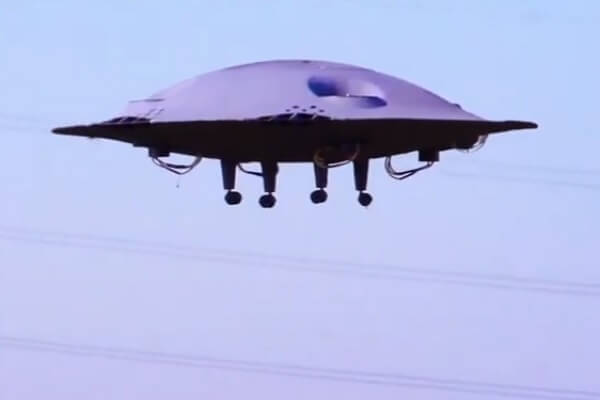
Romanian engineers have built a working flying saucer called ADIFO that draws its aerodynamic design from the body of a dolphin, and it could reshape how we think about aircraft maneuverability.
For many decades, UFOs were more a chimera of the mind of a science fiction filmmaker than anything else. The idea that a craft shaped like a disc could actually fly with any real control seemed to belong strictly in movies and late-night conspiracy theories. But now, Romanian engineers Razvan Sabie and Iosif Taposu have managed to turn that fiction into something tangible. They created a flying object in the form of a flying saucer, and it works. The name given to this device is ADIFO, which stands for All Directions Flying Object.
The concept behind ADIFO is deceptively simple, but the engineering is anything but. It has propellers that allow it to take off and land vertically, much like a drone or a helicopter. In turn, it has a propulsion system in the rear that makes it accelerate forward at considerable speed. If we combine the two things, we realize that the craft is so maneuverable that it is possible for the pilot to change direction sharply, hover in place, or even turn around completely mid-flight. That level of control in a disc-shaped aircraft is something that has eluded engineers for years, and it is exactly what makes ADIFO worth paying attention to.
As for the possibility of creating a UFO of this type with dimensions similar to those used in science fiction, the creators are cautious but optimistic. "It would be a revolutionary new flight paradigm," they have said. Scaling up the design presents a different set of challenges, from structural integrity to power requirements, but the foundational aerodynamics are sound. The proof is in the prototypes they have already built and tested.
ADIFO can not only fly, but it is also useful to the extreme because it can take any direction through its design. Unlike conventional aircraft that rely on fixed wings and tail rudders to steer, this craft uses its entire shape to manage airflow. In addition, the current prototype is extremely manageable because its dimensions do not exceed one meter in diameter, making it agile enough to operate in tight spaces where traditional drones or helicopters would struggle. The compact size also makes it an ideal test bed for refining the aerodynamic principles before building larger versions.
"The aerodynamics of this aircraft is the result of more than two decades of work and is very well argued, confirmed by computer simulations and wind tunnel tests," says Razvan Sabie. That is not a throwaway claim. Twenty years of iterative design, simulation, and physical testing have gone into making this disc actually fly the way its creators envisioned. The flying device works in a manner very similar to that of a drone in terms of its vertical capabilities, but its forward flight characteristics are closer to those of a jet. To develop it, its creators spent years studying natural forms. For their creation, they based the posterior cross section of the aircraft on the body of a dolphin, a shape that nature has refined over millions of years for efficient movement through fluid environments. Air, after all, behaves as a fluid at the speeds and scales relevant to flight.
The implications of a working flying saucer extend beyond novelty. If the design scales successfully, ADIFO could find applications in surveillance, search and rescue, agriculture, and even personal transportation. A craft that can take off vertically, hover silently, accelerate rapidly, and change direction on a dime has clear advantages over both fixed-wing aircraft and rotary drones. The fact that it achieves all of this with a shape inspired by one of the ocean's most efficient swimmers only adds to the elegance of the engineering. For now, the one-meter prototype is a proof of concept, but it is one that has survived wind tunnel testing and real-world flights. That is more than most aviation concepts can say at this stage. The next step will be watching whether Sabie and Taposu can secure the funding and partnerships needed to scale this dolphin-inspired disc into something that changes the skies.